

Here in this article we review the operating system interrupt fundamentals, types of OS interrupts and how an interrupt is handled by describing the interrupt handling sequence.
Table of Contents
Interrupt Fundamentals
An interrupt is a signal emitted by a device attached to a computer or from a program within the computer. It requires the operating system (OS) to stop and figure out what to do next. An interrupt temporarily stops or terminates the current process. [1]
An interrupt alerts the processor to a high-priority process requiring interruption of the current working process. In I/O devices one of the bus control lines is dedicated for this purpose and is called the Interrupt Service Routine (ISR).
While the processor is handling the interrupts, it must inform the device that its request has been recognized so that it stops sending the interrupt request signal. Also, saving the registers so that the interrupted process can be restored in the future, increases the delay between the time an interrupt is received and the start of the execution of the ISR. This is called Interrupt Latency. [2]
- The time interval between the occurrence of interrupt and start of execution of the ISR is called interrupt latency. [3]
Types of Interrupts:
Although interrupts have highest priority than other signals, there are many type of interrupts. [3]
- Hardware Interrupts
- The signal for the processor is from external device or hardware.
- Software Interrupts
Temporal Interrupt Classification
- Synchronous Interrupt
- Interrupts which are dependent on the system clock.
- Example: timer service that uses the system clock.
- Asynchronous Interrupt
- Interrupts are independent from the system clock. [3]
Periodic Interrupt Classification
- Periodic Interrupt
- The interrupts occurr at fixed intervals.
- Aperiodic Interrupt
- The occurrence of interrupt cannot be predicted. [3]
Interrupt handling
Interrupts are handled on the computer by special routine called an interrupt handler. There can be multiple interrupt handlers installed on a computer. The interrupt handler that is executed by the CPU depends upon the type of interrupt that is generated. [4]
Modern computer systems use a technique called interrupt service request (ISR).
- This allows the operating system to run the instructions in an interrupt context without getting into the regular program flow.
- This gives the system more flexibility and the ability to run more than one instruction at a time.
- The ISR handler can keep track of which instructions it has already run and can do things like cancel other scheduled instructions if they need to switch focus to handling the new interrupt.
Interrupt Handling Sequence
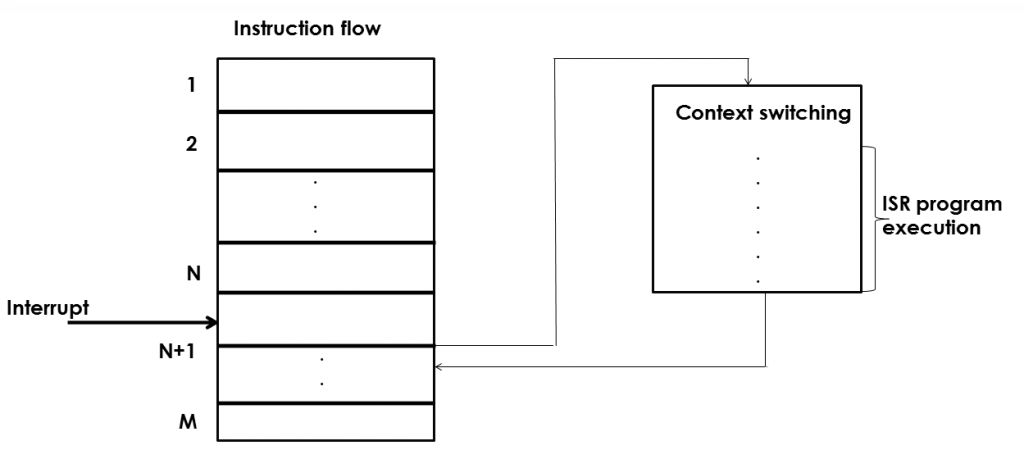
Suppose the CPU is performing task 1, and meanwhile, an interrupt comes to execute task 2(high priority). [4]
- The operating system preserves the state of the CPU by storing registers and the program counter of task 1.
- And do context switching(shifting to a new process).
- Determines which type of interrupt has occurred.
- Determine what action should be taken for each type of interrupt.
- After performing task 2, the CPU resumes the already running process(task 1) from the same state where it left off.
What is the difference between context switching and interrupt handling?
There isn’t a fundamental difference, it’s more a question of degree — the amount of context that needs to be saved.
When an RTOS thread context switch occurs, all of the CPU state that any thread might use must be saved. This usually includes all of the CPU registers, including flag or status registers, so that when they’re restored, the thread resumes as though nothing ever happened.
When an interrupt occurs, there’s still a context switch, but only the context that the interrupt handler actually needs to use needs to be saved and then subsequently restored.
If you write your interrupt handler in a high-level language, this will pretty much be equivalent to a full thread context switch, because there are no constraints on what resources such an interrupt handler might touch. However, if you write your interrupt handler in assembly language, you can keep track of exactly which registers it touches and save only those. This allows the execution of the interrupt handler to be extremely fast, reducing its impact on the rest of the system, and/or allowing it to handle interrupts at a higher rate.
Dave Tweed [5]
Interrupt Affinity
IRQ affinity, also known as interrupt affinity, is a concept in computer systems that allows you to assign specific processors or CPU cores to handle specific interrupt requests (IRQs).
IRQ affinity helps optimize how interrupts are processed by the CPU, leading to improved system performance. By assigning certain CPU cores to handle specific interrupts, you can distribute the workload more efficiently and avoid overwhelming a single core.
Here are a few important points to understand about IRQ affinity:
- Balancing Workload: IRQ affinity helps distribute the work of handling interrupts across different CPU cores. This prevents one core from getting overloaded with too many interrupts, which can slow down the system.
- Boosting Performance: By assigning specific CPU cores to handle particular interrupts, IRQ affinity can enhance the performance of your computer. It improves cache efficiency by ensuring that interrupt processing takes place on the same core as the associated cache, reducing delays.
- Adjusting Affinity: IRQ affinity can be configured at the operating system level using specific tools or settings. This allows you to control which CPU cores handle which interrupts. Different operating systems provide different methods for adjusting IRQ affinity.
- Using an Affinity Mask: IRQ affinity is typically set using an affinity mask, which is a bit mask representing CPU cores. By configuring the bits in the mask, you can specify which CPU cores are assigned to handle specific interrupts.
Optimizing IRQ affinity can enhance the overall performance and responsiveness of your computer. However, it’s important to note that finding the ideal IRQ affinity configuration may require experimentation and monitoring.
Interrupt Context
The “interrupt context” in computing refers to a special mode that the processor enters when it receives an interrupt signal from a hardware device. It is an environment where the CPU temporarily shifts its attention to handle the interrupt.
Here are a few key points to understand about the interrupt context:
- Definition: The interrupt context is a state in which the CPU operates when it receives an interrupt from a hardware device. It allows the CPU to handle the interrupt and perform necessary processing related to the event.
- Purpose: Interrupts are signals from hardware devices that require immediate attention from the CPU. The interrupt context enables the CPU to swiftly switch from regular program execution to handle the interrupt.
- Execution Flow: When an interrupt occurs, the CPU temporarily pauses the current program execution and jumps to a specific code known as the interrupt handler or interrupt service routine (ISR). The ISR is responsible for dealing with the interrupt event.
- Quick Execution: Interrupt handlers are designed to execute efficiently and quickly since they need to complete their tasks promptly. They typically perform essential operations related to the interrupt, such as saving relevant information and initiating further processing if needed.
- Return to Program: Once the interrupt handling is done, the CPU returns to the interrupted program and continues its execution from where it left off. This allows the regular program flow to resume seamlessly.
Interrupt Disabled Kernel Execution Context
The interrupt disabled kernel execution context refers to a situation where interrupts are temporarily turned off while the kernel is executing important code. This is done to ensure that the kernel can complete critical operations without any interruptions.
Here are a few key points to understand about the interrupt disable kernel execution context:
- Purpose: The interrupt disabled kernel execution context is established to prevent interrupts from occurring and interrupting crucial sections of the kernel code. It allows the kernel to execute specific code sequences without any interruptions.
- Interrupt Disabling: When the kernel enters this context, it disables interrupts to prevent any external interruptions. This is achieved by clearing the interrupt enable flag or setting a specific flag that blocks interrupt service.
- Critical Kernel Code: The interrupt disabled kernel execution context is typically used when executing critical sections of the kernel code that require uninterrupted execution. These sections often involve operations that need to be performed as a whole or require exclusive access to shared resources.
- Duration: The duration of the interrupt disable context is kept short to minimize any impact on system responsiveness. Once the critical code section is completed, interrupts are re-enabled to allow the CPU to respond to external interrupt requests again.
- Impact on System: While interrupts are disabled, the system may experience a temporary delay in responding to external events. However, this is a deliberate trade-off made by the kernel to ensure the integrity and consistency of critical kernel operations.
It’s important to note that disabling interrupts should be done carefully. The kernel controls the use of interrupt disabling to minimize the impact on system responsiveness and promptly re-enables interrupts after executing critical code sections.
By temporarily turning off interrupts during the execution of critical kernel code, the interrupt disable kernel execution context helps maintain the integrity and consistency of critical operations performed by the kernel.
SoftIRQ (Software Interrupt)
In operating systems, a SoftIRQ (Software Interrupt) is a mechanism used to handle high-priority, non-maskable software events in a timely and efficient manner. SoftIRQs provide a way to defer and handle certain types of interrupt-like events within the kernel itself, without relying on hardware interrupts.
Here are some key points to understand about SoftIRQs:
- Software Events: SoftIRQs are triggered by software events rather than hardware interrupts. These events can include network packet processing, timer expiration, task scheduling, I/O completion, and other time-critical activities within the kernel.
- Priority and Handling: Each SoftIRQ is associated with a specific priority level, allowing the kernel to prioritize the processing of different types of events. The SoftIRQ handler, also known as the SoftIRQ bottom half, is responsible for handling the event associated with the SoftIRQ.
- Deferred Execution: SoftIRQs provide a mechanism for deferred execution, allowing the kernel to handle certain events in a delayed manner. Instead of immediately handling an event within the context of the triggering code, SoftIRQs allow the kernel to defer the processing to a more suitable time, reducing interrupt latency and improving overall system performance.
- SoftIRQ Context: When a SoftIRQ is triggered, it runs in the context of the current kernel thread, also known as the SoftIRQ context. The SoftIRQ handler executes within this context, utilizing the kernel’s resources and data structures to handle the specific event.
- Bottom Half: The SoftIRQ handler is often referred to as the SoftIRQ bottom half because it is executed as part of the kernel’s deferred processing mechanism. It performs the necessary actions associated with the event, such as data processing, scheduling, I/O operations, or signaling other parts of the kernel or user space.
- SoftIRQ vs. Hardware Interrupts: SoftIRQs provide a more controlled and predictable mechanism for handling time-critical software events compared to hardware interrupts. They offer a way to efficiently handle high-priority events within the kernel without requiring the overhead of switching between user and kernel modes or relying on external hardware signals.
SoftIRQs are an integral part of the Linux kernel and are used extensively to handle various high-priority software events. They help ensure efficient and timely processing of critical tasks within the kernel, contributing to the overall responsiveness and performance of the operating system.

Threaded Interrupts
[6]
- A threaded IRQ handler will allow to execute work that can potentially sleep in a
kernel thread.- One kernel thread is created for each interrupt line that was requested as a threaded IRQ.
Threaded interrupts, also known as threaded IRQs (Interrupt Requests), are a technique used in operating systems to handle hardware interrupts in a more controlled and efficient manner. Unlike traditional interrupt handling, which is typically executed within the context of an Interrupt Service Routine (ISR), threaded interrupts allow the processing of interrupts to be threaded, meaning they can be handled within the context of a kernel thread.
Here are some key points to understand about threaded interrupts:
- Interrupt Handling: When a hardware interrupt occurs, the processor halts its current execution and transfers control to the ISR associated with that interrupt. In traditional interrupt handling, the ISR is executed in the context of an interrupt, and its execution is prioritized over other tasks.
- Threaded Interrupts: With threaded interrupts, instead of executing the entire interrupt handling within the ISR, the ISR quickly acknowledges the interrupt and schedules the remaining interrupt processing to be performed by a dedicated kernel thread. The interrupt handling is then continued within the context of that thread.
- Deferred Processing: By offloading the remaining interrupt processing to a threaded kernel thread, the ISR can complete quickly, reducing the interrupt latency and allowing the system to resume normal operations faster. The threaded interrupt handler can then continue the processing at a more suitable time, without disrupting the normal execution flow of the system.
- Threaded Interrupt Handler: The threaded interrupt handler is responsible for processing the remaining tasks associated with the interrupt. It runs in the context of a kernel thread and can utilize the full range of kernel facilities and resources to handle the interrupt’s requirements. This includes accessing shared data structures, performing complex computations, and interacting with other kernel components.
- Benefits: Threaded interrupts offer several benefits. They provide greater flexibility and control over interrupt handling, allowing the system to prioritize and manage interrupt processing more effectively. They also help improve overall system responsiveness by minimizing interrupt latency and avoiding long-running ISRs that may disrupt the normal execution flow.
- Scalability: Threaded interrupts are particularly beneficial in systems with multiple interrupts or high interrupt rates. By distributing the interrupt processing across multiple threads, threaded interrupts can better utilize multi-core or multi-processor systems, ensuring efficient handling of concurrent interrupt events.
It’s important to note that the implementation and support for threaded interrupts may vary across different operating systems and hardware architectures. The use of threaded interrupts requires proper synchronization mechanisms and careful management to ensure correct and reliable interrupt handling.
References
[1] Rahul Awati, “interrupt,” WhatIs.com, 2022. https://www.techtarget.com/whatis/definition/interrupt#:~:text=An%20interrupt%20is%20a%20signal,service%20or%20a%20current%20process. (accessed Oct. 04, 2022).
[2] “Interrupts – GeeksforGeeks,” GeeksforGeeks, Sep. 03, 2019. https://www.geeksforgeeks.org/interrupts/ (accessed Oct. 04, 2022).
[3] Administrator, “Types of Interrupts | How to Handle Interrupts? | Interrupt Latency,” Electronics Hub, Aug. 20, 2015. https://www.electronicshub.org/types-of-interrupts-and-how-to-handle-interrupts/ (accessed Oct. 05, 2022).
[4] Naukri.com, 2020. https://www.naukri.com/learning/articles/interrupts-in-operating-system/ (accessed Oct. 05, 2022).
[5] the, “What is the difference between context switching and interrupt handling?,” Electrical Engineering Stack Exchange, Nov. 10, 2014. https://electronics.stackexchange.com/questions/137895/what-is-the-difference-between-context-switching-and-interrupt-handling (accessed Oct. 05, 2022).
[6] “Linux debugging, profiling and tracing training Linux debugging, profiling and tracing training.” Available: https://bootlin.com/doc/training/debugging/debugging-slides.pdf. [Accessed: Jun. 24, 2023]